
Toronto 2025-2026 Rodent Crisis: Complete Prevention & Control Guide


Understanding the Rodent Crisis
If you've noticed increased rat activity on Toronto streets recently, you're observing a documented crisis. Between August 2024 and July 2025, rodent-related service requests surged 35% across the Greater Toronto Area a dramatic escalation that prompted Toronto City Council to approve the city's first comprehensive Rat Response Plan in July 2025.
The trajectory tells a sobering story:
| Year | Rodent Complaints | Year-over-Year Growth | ||
| 2019 | 940 | Baseline | ||
| 2023 | 1,600 | +70% | ||
| 2024 | 2,523 | +58% | ||
| 2025 | 3,400+ (projected) | +35% |
This escalation isn't coincidental it reflects a perfect storm of environmental, infrastructural, and behavioral factors that Toronto experts describe as unprecedented. The good news? Toronto's new $501,000 annual investment and data-driven strategies offer hope. This guide breaks down what you need to know and do right now.
Understanding the Root Causes
Climate Change: The Hidden Accelerant
Climate change isn't just affecting polar bears, it's creating ideal conditions for rodent reproduction in the GTA. Warmer winters mean Norway rats can now reproduce virtually year-round, with females producing up to 12 litters annually. Each litter contains 6-12 pups that reach sexual maturity in just 3-4 months.
Do the math: one pair of rats can theoretically produce thousands of descendants in a single year under favorable conditions. Toronto Public Health has identified this extended breeding cycle as a major factor driving the current surge.

Construction-Driven Displacement
Toronto's warming winters have fundamentally altered rodent biology. Traditionally, harsh cold killed significant portions of rat populations each January. That natural population control mechanism is disappearing.
The Numbers That Matter:
● Norway rats now breed virtually year-round in Toronto, rather than seasonally
● Females produce up to 12 litters annually (vs. historically 4-6)
● Each litter contains 6-12 pups reaching sexual maturity in just 3-4 months
● Population doubling time: 60-90 days under favorable conditions
● Real-World Impact: One breeding pair can theoretically produce thousands of ● descendants within 12 months. Toronto Public Health's 2025 Climate ●Assessment directly links the extended breeding cycle to the current surge.
Real-World Impact: One breeding pair can theoretically produce thousands of descendants within 12 months. Toronto Public Health's 2025 Climate Assessment directly links the extended breeding cycle to the current surge.
We're no longer seeing winter as a natural population control mechanism. That changes everything about how we approach rodent management," says Dr. Sarah Chen, Toronto Public Health's Pest Management Coordinator.
Construction Displacement: Moving Rats, Not Eliminating Them
Major infrastructure projects—particularly the Ontario Line expansion and Metrolinx developments—are creating unexpected consequences. When excavation destroys established underground burrows, rat colonies don't vanish; they migrate to adjacent residential and commercial areas.
High-Risk Construction Zones (2025-2026):
● Caledonia Road & Rogers Road corridor
● Metrolinx transit expansion sites (multiple neighborhoods)
● Downtown development corridors (King West, Queen West)
● Residential areas adjacent to Yonge Street subway expansion
● Lawrence Avenue infrastructure work affecting North York properties
Case Study: Between March and August 2025, neighborhoods within 500 meters of the Caledonia/Rogers construction site reported a 42% increase in rodent complaints. Property owners in the area confirm receiving 311 requests for rat control increased from 8-12 monthly to 25-30 monthly during peak construction phases.
Mitigation Strategy for Affected Residents: If your property is within 500 meters of active construction, consider pre-emptive exclusion work now rather than waiting for evidence of infestation.

Strategies for Landlords and Multi-Residential Properties
Legal Responsibilities
Landlords in Ontario have clear obligations under the Residential Tenancies Act (RTA). Rental properties must be maintained free from rodent infestations. When tenants report problems, landlords must respond promptly with professional pest control services.
Consequences of non-compliance:
● Applications to the Landlord and Tenant Board
● Potential rent abatements
● Orders requiring immediate remediation
● City-contracted work with full cost recovery
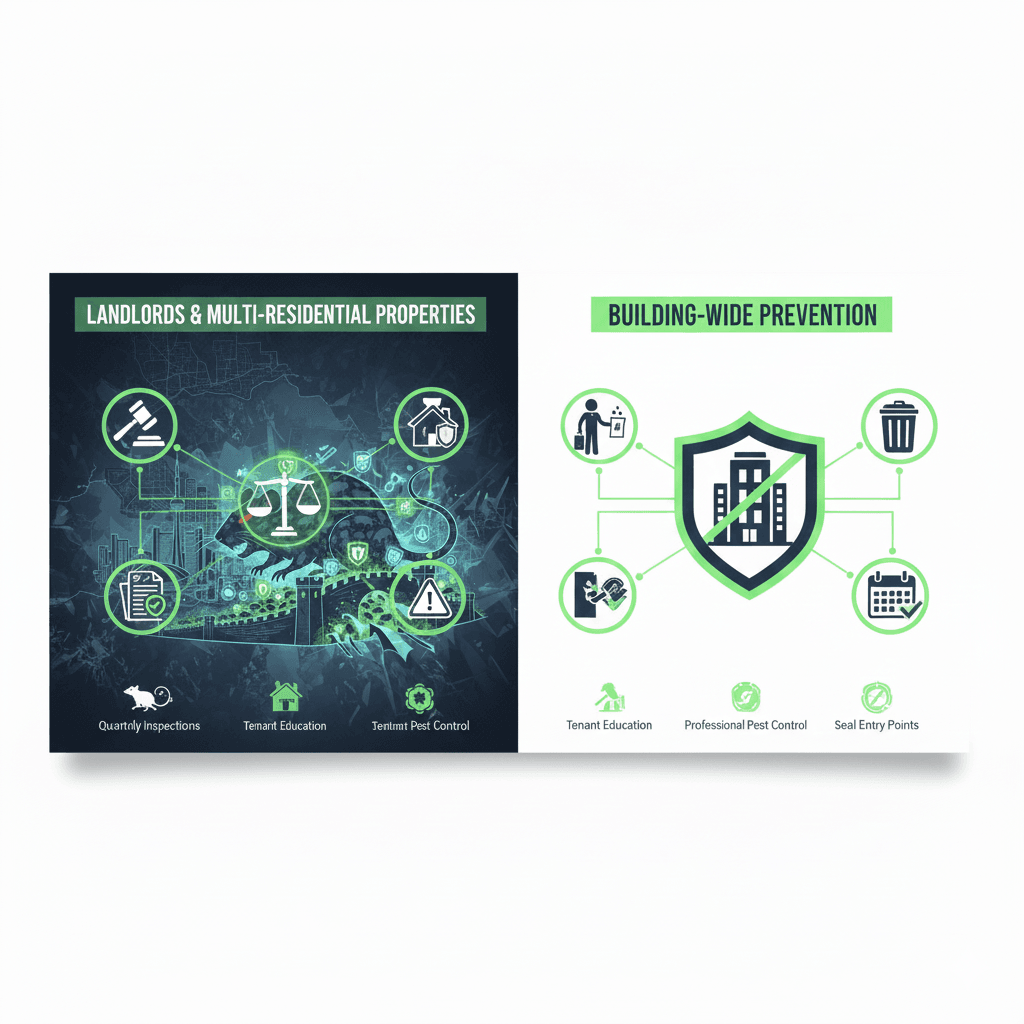
Building-Wide Prevention
Effective rodent control in apartment buildings requires comprehensive approaches:
Regular maintenance protocols:
● Conduct quarterly inspections of common areas and mechanical rooms
● Maintain garbage chute rooms with daily cleaning
● Seal shared walls and service penetrations between units
● Schedule preventive pest control services, not just reactive responses
Tenant engagement:
● Implement education programs on proper waste disposal
● Provide multilingual materials reflecting tenant populations
● Encourage early reporting with clear procedures
● Foster collaborative responsibility for building-wide prevention
When to Call Professional Pest Control
Recognizing Infestation Signs
Early detection dramatically improves treatment success. Watch for:
Physical evidence:
Droppings: Capsule-shaped, 12-18mm long, found along walls and near food
Gnaw marks: Fresh marks appear lighter on wood, plastic, and wires
Tracks and smudges: Greasy rub marks along walls and baseboards
Burrows: 2-4 inch diameter holes near foundations or under decks
Behavioral indicators:
● Scratching or scurrying sounds, especially at night
● Distinctive musky odor from urine marking
● Pet behavior changes (excessive interest in walls or corners)
Choosing Licensed Services
When selecting professional rodent control:
Verify credentials:
● Confirm licensing through Structural Pest Management Association of Ontario (SPMAO)
● Check online reviews and Better Business Bureau ratings
● Request references from similar properties
Understand the approach:
● Demand detailed inspection reports
● Ensure treatment includes exclusion work, not just poison
● Ask about follow-up visits and warranties
● Clarify pricing structure upfront
Cost expectations:
● Residential initial treatment: $200-600
● Extensive exclusion work: Additional $700-1500
● Multi-residential buildings: $1,500-3,000+ for comprehensive programs
● Commercial monthly contracts: $100-750

Understanding Toronto's Bylaws
Property Standards Requirements
Toronto Municipal Code Chapter 629 establishes enforceable standards:
Section 9: Property owners must maintain premises free from rodent infestation and eliminate conditions conducive to pest harbourage.
Section 10B: Mandates yard maintenance including vegetation control, debris removal, and elimination of rodent-attracting materials.
Enforcement process:
● Inspection by Municipal Licensing and Standards
● Order to Comply issued with 30-90 day deadline
● Failure results in city-contracted remediation
● Full cost recovery plus administrative fees
● Potential provincial offences charges with significant fines
Waste Collection Compliance
Chapters 844 (residential) and 841 (commercial) govern waste management:
Container requirements:
● Approved containers with tight-fitting lids mandatory
● Storage on private property except collection day
● Placement at curb no earlier than 7 PM night before
● Retrieval by 11 PM on collection day
Food establishments face additional DineSafe program requirements, with rodent evidence resulting in conditional passes or closure until remediated.
Health and Safety Considerations
Realistic Risk Assessment
Toronto Public Health maintains that while rodents carry disease potential, actual transmission risk remains relatively low with proper precautions. However, rats can harbor bacteria and pathogens including leptospirosis and salmonella.
Primary concerns:
● Food contamination in homes and restaurants
● Property damage to wiring, insulation, and structures
● Mental health impacts from stress and anxiety
● Sleep disruption and reduced quality of life
Safe Cleanup Practices
If handling rodent contamination:
Never sweep or vacuum (aerosolizes particles)
● Spray area with disinfectant, let soak 5 minutes
● Remove with damp paper towels while wearing gloves
● Use N95 mask for extensive cleanup
● Dispose in sealed plastic bags
Disinfect thoroughly:
● Use commercial disinfectant or bleach solution (1:10 ratio)
● Allow proper contact time
● Wash hands thoroughly after, even with gloves
For extensive contamination, hire professional biohazard remediation services.
Learning from Other Cities
New York City's Rat Czar
NYC appointed its first "Rat Czar" in 2023, establishing rat mitigation zones with intensive intervention. Their "Rat Academy" trains community groups in best practices, a model Toronto's plan incorporates through community education components.
Chicago's Dedicated Bureau
Chicago's Bureau of Rodent Control demonstrates that sustained commitment can manage populations even in large, dense cities. Their data-driven approach using complaint mapping to allocate resources mirrors Toronto's strategy.
Alberta's Success Story
Alberta remains virtually rat-free through aggressive border control and rapid response. While not replicable in established urban environments, their success proves comprehensive, well-funded programs achieve dramatic results when implemented early.

Conclusion: Taking Action Now
The 2025-2026 rodent crisis facing the Greater Toronto Area is significant but not insurmountable. Success requires coordinated effort: the City of Toronto implementing its Rat Response Plan, landlords maintaining standards, professional pest control companies delivering effective services, and residents practicing vigilant waste management.
Your action plan:
● Inspect your property for entry points this week
● Seal identified gaps using metal mesh and proper materials
● Secure all garbage and compost in approved containers
● Maintain yard vegetation to bylaw standards
● Report problems promptly through 311
The rodent crisis didn't develop overnight and won't disappear instantly. But with sustained commitment and community cooperation, Toronto can achieve meaningful population reductions. Start with your own property today your individual actions, multiplied across thousands of properties, create the collective impact necessary to turn the tide.
Frequently Asked Questions
Is there a rat problem in Toronto?
Yes. Toronto faces a significant rat problem due to dense urban infrastructure, construction, food waste, and warm building basements. Rats thrive in neighborhoods with older housing, easy food access, and cluttered alleyways. Continuous population growth and milder winters also contribute to increasing rat activity across the city.
What is the rat response plan in Toronto?
Toronto’s rat response plan focuses on improving waste management, enforcing property standards, educating residents, sealing municipal gaps, and increasing pest control support in high-risk neighborhoods. The city also coordinates with public health teams to reduce food sources, manage sewer-related rat issues, and support community-based prevention measures.
What smell do rats hate the most?
Rats strongly dislike the smell of peppermint oil, ammonia, vinegar, clove oil, and predator scents. These odors can help deter rats temporarily, but they do not replace proper exclusion, sanitation, and professional control methods. Scent-based repellents work best when combined with sealing entry points and removing attractants.
Are cockroaches a problem in Toronto?
Yes. Cockroaches are a growing issue in Toronto, especially in apartments, older buildings, and high-density areas. German cockroaches spread quickly, thrive in warm, humid environments, and hide in cracks and kitchens. Infestations often require professional treatment because DIY methods rarely eliminate hidden nests and egg cases.
Can naphthalene balls keep rats away?
Naphthalene balls provide only mild, temporary repellent effects. Their smell is not strong enough in open spaces to drive rats out, and high concentrations can be unsafe for humans and pets. They do not replace proper sealing, sanitation, or professional rodent control methods.
Do dryer sheets keep mice away?
Dryer sheets do not effectively repel mice. While the scent may momentarily discourage them, mice quickly adapt. They will still enter homes if there are food sources, gaps, or nesting areas. Proper exclusion and professional treatment are much more reliable for long-term mouse prevention.
What smell is toxic to rats?
Strong chemical fumes like ammonia or concentrated peppermint oil can be irritating or harmful to rats, but relying on toxic smells is unsafe and ineffective. These odors rarely eliminate infestations. Safe, proven methods, traps, exclusion, and professional control are necessary for complete rat removal.
What month are rats most active?
Rats are active year-round but peak activity occurs from September to February, when colder temperatures drive them indoors for warmth and food. During these months, they breed rapidly, seek shelter in basements and walls, and become more visible around homes, garbage areas, and commercial buildings.