
Cockroach Control in Restaurants: Prevention & Emergency Response

A customer spots a cockroach near your food prep counter, pulls out their phone, and within hours, your restaurant is trending in local Facebook groups for all the wrong reasons. This is not a worst-case scenario. It is a Tuesday night reality for Canadian restaurant owners who underestimate how fast a cockroach situation can spiral.
Cockroach control in restaurant management in Canada sits directly inside your legal obligations under the Safe Food for Canadians Regulations (SFCR). The Canadian Food Inspection Agency (CFIA) treats cockroach infestations as a serious public health risk and inspects for documented pest management programs as part of every food facility audit. Whether your kitchen is in Vancouver, Calgary, Toronto, or Halifax, the rules are the same, and the consequences of ignoring them are real. This guide walks you through the full picture.
The Real Reason Cockroach Problems Get Out of Hand in Canadian Restaurants
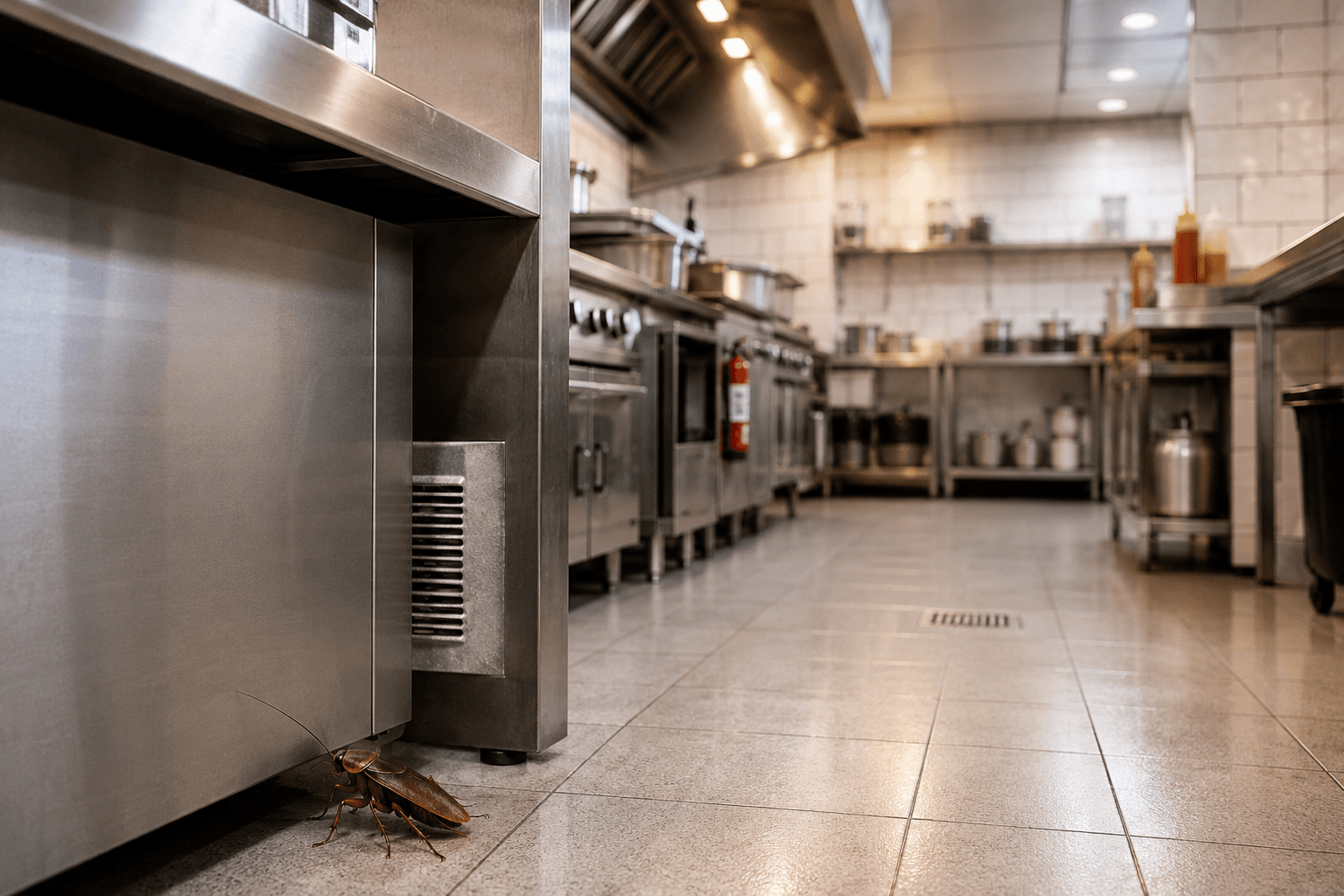
Most Canadian restaurant owners do not discover a cockroach infestation because they are watching for one. They discover it because a customer did first, or because a health inspector found droppings under the prep counter during a routine visit.
This is the core problem with cockroach control in restaurant management across Canada. The German cockroach, the species most commonly found in Canadian commercial kitchens, reproduces at a rate that most operators simply do not account for. A single egg capsule, called an ootheca, carries between 30 and 40 eggs. Those nymphs reach reproductive maturity within weeks, and the colony multiplies quietly behind walls, under equipment, and inside cabinet voids long before any visible signs appear.
By the time you spot a live cockroach during daylight hours, which is itself one of the clearest infestation signs, the population behind your kitchen walls has almost certainly been established for months. The German cockroach does not come out during the day unless the harborage sites are overcrowded, which means a single daytime sighting is a late-stage warning, not an early one.
The biological hazard these pests carry makes the situation even more serious. Cockroaches transfer Salmonella, E. coli, and the Hepatitis virus onto every food contact surface they cross. Their fecal contamination, shed exoskeletons, and oily secretions create both foodborne illness risk and allergen contamination concerns for customers with respiratory conditions.
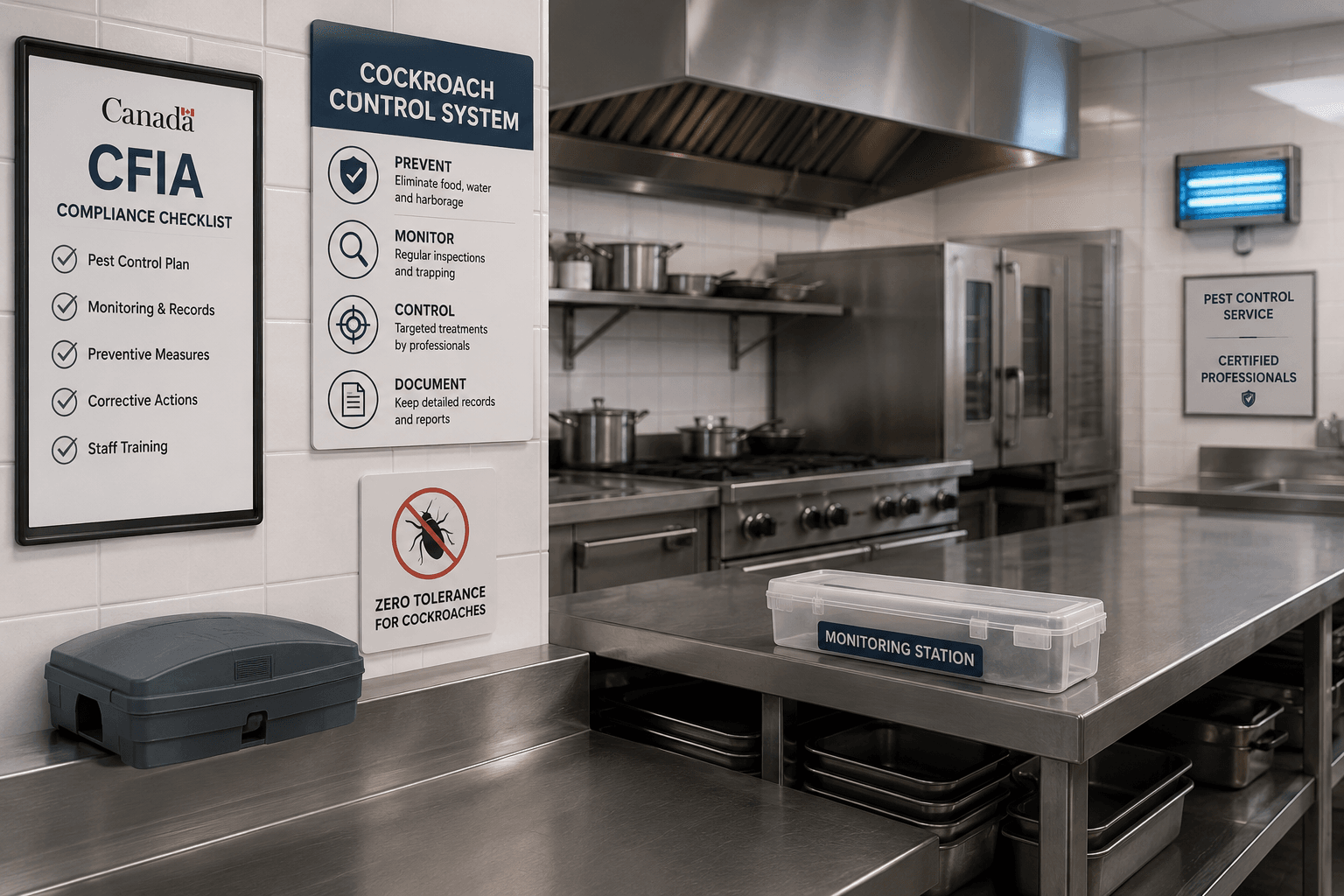
Under the SFCR, pest control is a preventive control requirement embedded directly in your Preventive Control Plan (PCP). The CFIA does not just check for live pests during an inspection. They check for your device map, your signed service reports, your corrective action records, and your employee training documentation. A kitchen without that paperwork receives a non-compliance finding even if no cockroach is physically present on inspection day.
This is why operators who think of cockroach control as something you deal with reactively always end up in trouble. The system needs to exist and be documented before the problem appears, not after.
How to Build a Cockroach Control System That Satisfies CFIA and Protects Your Kitchen
Effective cockroach control in restaurant management in Canada follows a clear sequence. Here is how to build it properly.
Start With a Harborage Assessment
Walk your entire facility and look in every spot your regular cleaning routine misses. Check behind kitchen sinks and drain boards, under counter plumbing, around water heaters, inside the upper corners of cabinets, behind drawers, along baseboards, and around utility pipes where they pass through walls. The County of Riverside Department of Environmental Health identifies these exact locations as the most reliable harborage sites for cockroaches in any food facility.
Look for coffee-ground-like material near wall cracks and under shelving. That is cockroach excrement, and it tells you precisely where the infestation is concentrated.
Remove Everything Cockroaches Need to Survive
Habitat alteration is the most impactful long-term strategy for cockroach prevention in Canadian restaurants. Take away their food, water, and shelter, and your facility becomes genuinely hostile to them. Store all ingredients in airtight containers of hard plastic, glass, or metal and keep them at least six inches off the floor. Never leave food residue on counters, sinks, or floors overnight. Empty garbage bins with tight-fitting lids before they overflow. Fix every dripping faucet, leaking pipe, and condensation problem in the kitchen. Eliminate all standing water near floor drains daily. Remove cardboard boxes from your facility the same day they arrive because cockroach eggs inside cardboard hatch once the boxes enter a warm indoor space.
Seal Every Entry Point
Use caulk or foam to seal cracks in walls, floors, and ceilings. Install door sweeps and weather stripping on all exterior doors. Use steel wool or mesh around utility pipe openings. Fit all floor drain covers properly. Replace or repair any shelving or tables with crevices or voids that create harborage space inside your kitchen.
Install and Monitor a Device System
Work with a licensed commercial pest management provider like Pest Troopers to place roach traps, bait stations, and mechanical traps at key locations, including under sinks, in cabinets, near stoves and refrigerators, and around floor drains. Every device must be numbered, included on a signed, dated facility schematic, and inspected on a fixed schedule.
Raise all large kitchen equipment at least six inches off the floor or seal it to the surface to eliminate harborage space underneath.
Maintain Monthly Professional Inspections
Monthly pest control inspections are the minimum frequency required under the SFCR. Your contracted pest control provider must supply a written service report after every visit documenting findings, pesticide products applied with their PCP registration number and concentration, and all corrective action recommendations. Under Canadian regulations, chemical control applications in food facilities must be performed only by certified licensed pest control operators using approved pesticides.
Document Your Employee Training
Every staff member needs documented training on cockroach infestation signs, including dark droppings, egg casings, shed skins, grease trails, musty odors, and daytime cockroach sightings. Training records must show names, dates, topics covered, and the trainer's identity. These records are reviewed during CFIA audits.
Real Situations That Show Why System and Speed Both Matter
Here are scenarios that reflect what Canadian restaurant operators genuinely face during cockroach crises and what separates the ones that recover quickly from the ones that do not.
A restaurant in downtown Toronto undergoes a routine Toronto Public Health inspection. The inspector opens a cabinet beneath the prep counter and finds cockroach droppings and two egg casings. No live cockroaches are visible. The owner insists the kitchen is regularly cleaned. But there is no signed pest control service report on file and no device map. The result is a conditional pass, a non-compliance notice, a mandatory corrective action order, and a publicly posted health inspection report the same week.
A catering operation in Mississauga finds a significant cockroach harborage behind a commercial refrigerator during a late-night cleaning shift. Droppings, shed skins, egg casings, and grease trails cover the back wall. Because the operation has a proper pest management plan and a contracted commercial pest control provider, the manager calls the emergency line immediately. The provider arrives the next morning, applies targeted chemical control using approved pesticides, and delivers a written emergency service report the same day. The CFIA follow-up audit finds the facility fully compliant. The operation never closes.
The contrast is entirely about documentation and an existing professional relationship. The Toronto restaurant had a cleaner appearance but no system. The Mississauga operation had a system, and it protected them completely.
This pattern holds across Canada. The CFIA and provincial health authorities consistently treat the absence of a documented pest management program as seriously as an active infestation itself. Your paperwork is your protection.
It is also worth noting that incoming deliveries are one of the most underestimated entry routes for cockroaches in Canadian food facilities. Produce crates, cardboard packaging, and supply shipments can carry egg capsules and live cockroaches directly into your storage areas without any visible signs during a quick visual check. A documented receiving inspection procedure that checks every delivery before it enters storage closes this gap and demonstrates due diligence during regulatory audits.
Additional Habits That Keep Restaurant Kitchens Cockroach-Free
Staying ahead of cockroach control restaurant compliance in Canada requires a few consistent habits beyond the foundational steps.
Clean grease traps on schedule without exception. Grease buildup in traps and along floor drains creates exactly the moist, food-rich environment that cockroaches return to consistently. This is one of the most neglected maintenance tasks in busy Canadian kitchens.
Move large appliances during every deep cleaning session. Cockroaches gather behind refrigerators, ovens, dishwashers, and fryers because these units generate heat, collect food debris, and are rarely moved. Cleaning around them rather than moving them leaves the most productive harborage sites completely untouched.
Update your pest control device map anytime your kitchen layout changes. A bait station blocked by new shelving is no longer functioning. An outdated map creates the appearance of a working system without the reality behind it.
In older Canadian commercial buildings, pay attention to shared walls with neighbouring businesses. Cockroach populations displaced from a neighbouring unit undergoing renovations or a business closure frequently migrate through wall voids and shared plumbing into adjacent kitchens. Alert your pest control provider whenever significant changes happen next door.
Build the System Before the Problem Builds Itself
Effective cockroach control restaurant management in Toronto is not something you build after a problem appears. It is something you maintain every single day so that problems either never develop or get caught early enough to be resolved quietly.
The operators who come through CFIA audits and health inspections without issues are the ones who treat pest management as a core part of their food safety system, not an afterthought. They have the device maps, the service reports, the training records, and the professional relationships that make a fast, effective response possible when anything unexpected happens.
Build your cockroach prevention system into your Preventive Control Plan now, document everything consistently, and work with professionals who understand the Canadian regulatory environment.
Got a cockroach concern in your Toronto restaurant? Contact Pest Troopers today.
Frequently Asked Questions
Q1. Can a restaurant be shut down for cockroaches?
Yes. Under the SFCR and provincial food safety regulations, a confirmed cockroach infestation in a food facility constitutes a public health risk serious enough to trigger an immediate closure order. Even indirect signs like droppings or egg casings can result in a conditional pass, mandatory corrective actions, and a follow-up inspection within days.
Q2. What are the earliest warning signs of cockroaches in a restaurant kitchen?
The earliest signs include dark pepper-like droppings behind equipment and under sinks, brown or black egg casings in hidden areas, a musty, oily odor in the kitchen, grease trails along baseboards, and gnaw marks on food packaging. Any daytime sighting of a live cockroach is a late-stage warning that the infestation is already well established.
Q3. How do cockroaches most commonly enter restaurants?
Cockroaches most commonly enter through incoming deliveries in cardboard boxes and produce crates, through cracks and gaps around utility pipes in shared walls, through floor drains and sewer connections, and through gaps under exterior doors. In multi-unit commercial buildings, they also travel between units through wall voids and ventilation systems.
Q4. How often must restaurants schedule professional pest inspections?
Monthly professional pest control inspections are the minimum required frequency under the SFCR while operations are active. Every visit must produce a written service report documenting findings, pesticide products used with PCP registration numbers, and corrective action recommendations kept on file for at least two years.
Q5. Can restaurant owners inToronto apply cockroach pesticides themselves?
Basic preventive measures like trapping and sealing entry points are permitted for self-management. However, chemical control applications in food facilities must be performed only by certified licensed pest control operators using approved pesticides registered for use in Canada. Applying commercial pesticides without proper certification creates both a food safety compliance violation and a legal liability.
Q6. How does cockroach contamination directly threaten food safety in Canadian restaurants?
Cockroaches transfer Salmonella, E. coli, and the Hepatitis virus onto food prep surfaces and stored ingredients as they move through a food facility. Their droppings, shed exoskeletons, and dried airborne fecal particles are documented respiratory allergens that can trigger allergic reactions and serious respiratory conditions in sensitive customers and staff.