
What are Those Red Bugs with Black Markings You Keep Seeing? Everything About Boxelder Bugs


If you've noticed clusters of red bugs with black markings crawling along your home's exterior or gathering near your windows, you're almost certainly looking at boxelder bugs. They show up by the hundreds in certain seasons, and while the sight can be alarming, these bugs are one of the least harmful pests you'll encounter as an Ontario homeowner. This guide covers exactly what they are, why your home is attracting them, and how to keep them out for good.
What Are Boxelder Bugs?
The red bugs with black markings you're seeing are almost certainly boxelder bugs (Boisea trivittata). Despite their beetle-like look, they aren't beetles at all — they belong to the Rhopalidae family, known as "scentless plant bugs," a detail that separates them from stink bugs and other look-alikes.
How to identify boxelder bugs
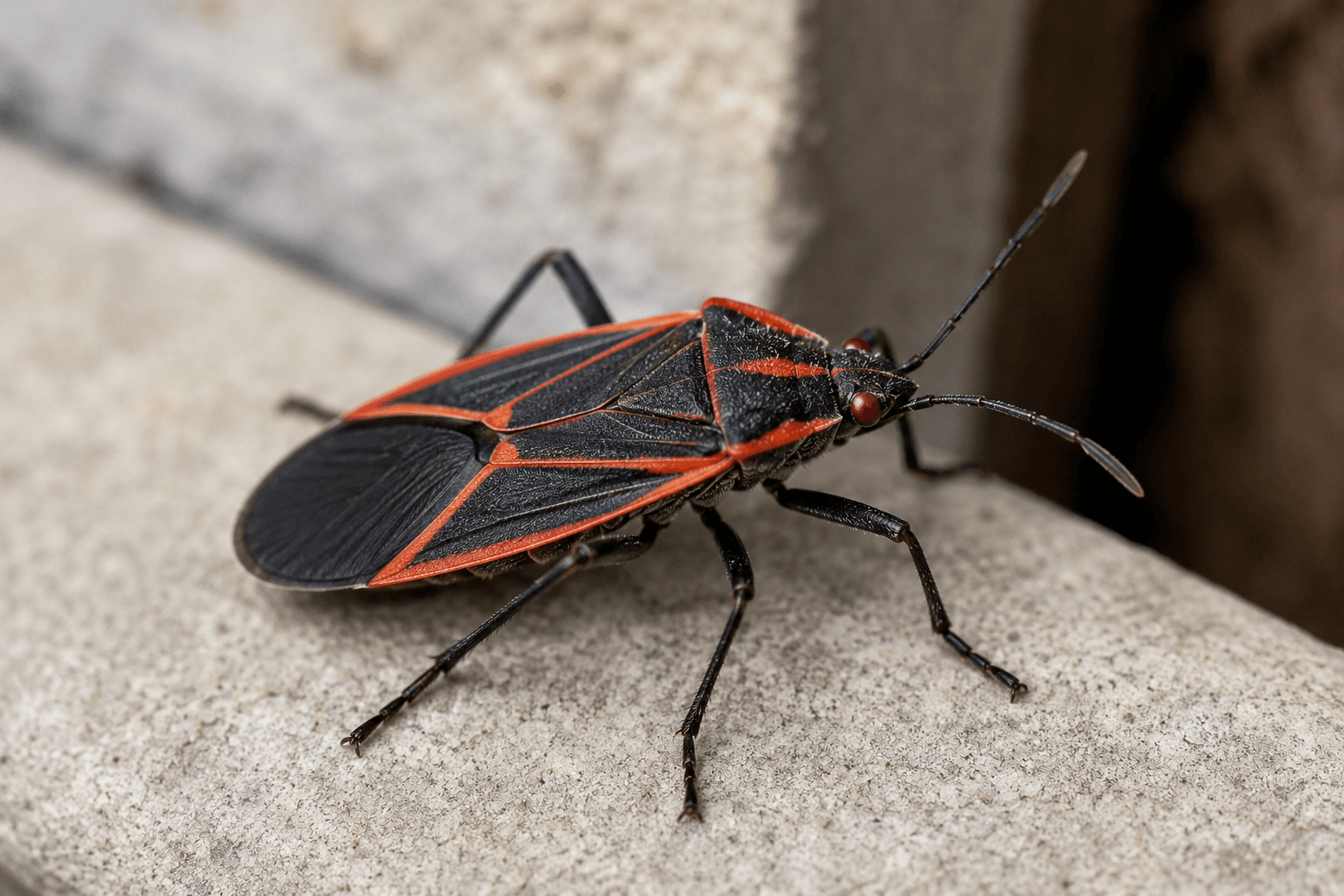
Adult boxelder bugs are dark brown to black, roughly 12–13 millimetres long, with a flattened, oval body. Their most recognizable feature is the pattern of red or orange lines running along the edges of their wings and across the thorax — often described as forming a rough X or V shape. Their eyes are also reddish, adding to the distinctive look.
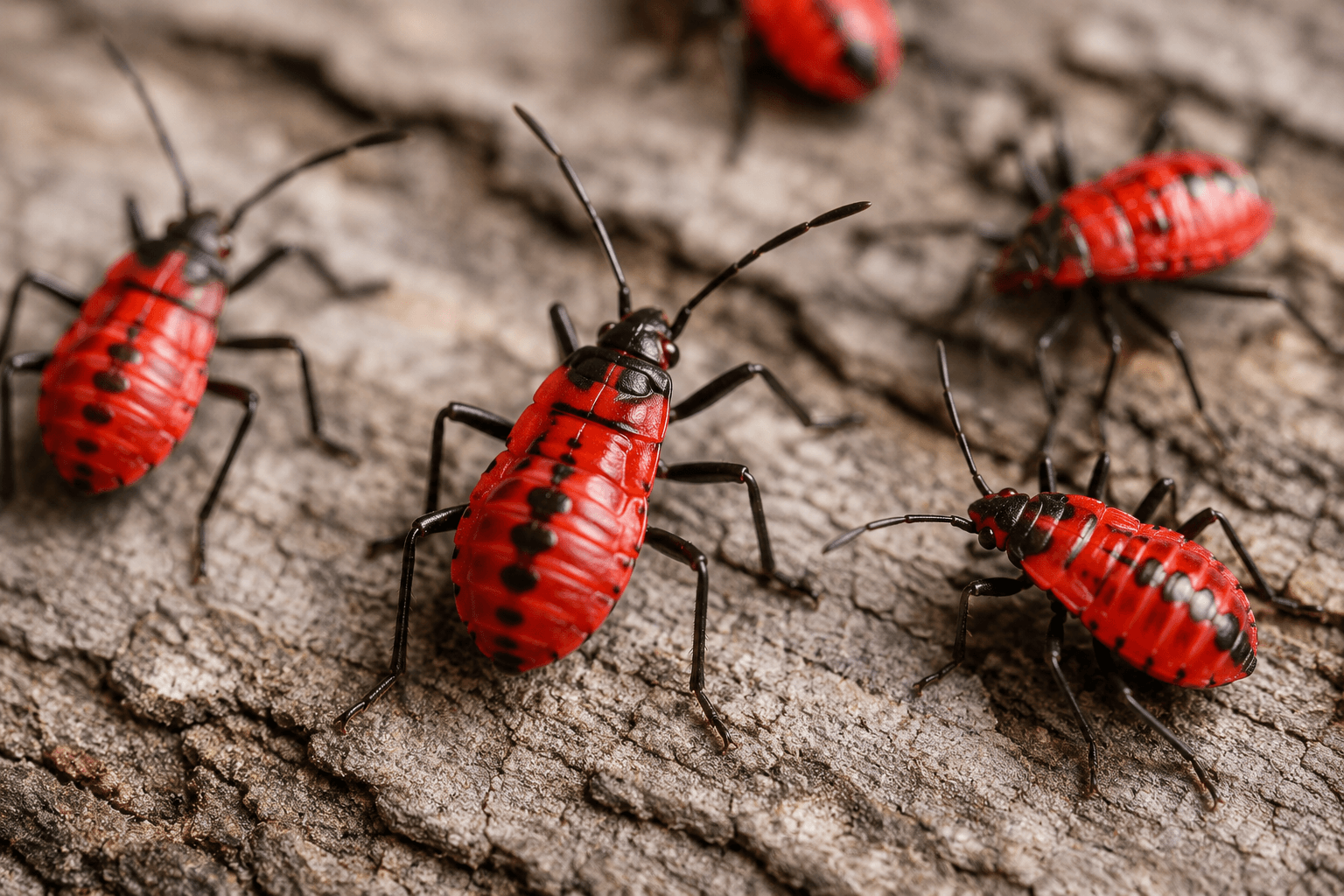
Nymphs (the immature stage) look very different from adults. They hatch bright red and wingless, and gradually darken as they mature, developing small black wing buds before their final moult into winged adults.
Where boxelder bugs come from
Boxelder bugs get their name from their primary host tree, the boxelder — better known in Ontario as the Manitoba maple (Acer negundo). They feed mainly on the seeds, leaves, and tender shoots of this tree, along with other maples and ash trees. Anywhere Manitoba maples grow in numbers — which includes many established GTA neighbourhoods — you can expect boxelder bug activity to follow. Areas of Toronto such as North York and Etobicoke, where Manitoba maples are especially common, have seen particularly large boxelder bug numbers in recent years.
Eastern vs. Western Boxelder Bugs in Canada
Most of the boxelder bugs you'll see across Ontario and the rest of eastern Canada are the Eastern boxelder bug (Boisea trivittata). A related species, the Western boxelder bug (Boisea rubrolineata), is found instead from British Columbia eastward through the interior — the two species look almost identical and behave the same way, but they occupy different parts of the country. If you live in the GTA or South Simcoe region, the Eastern species is what you're dealing with.
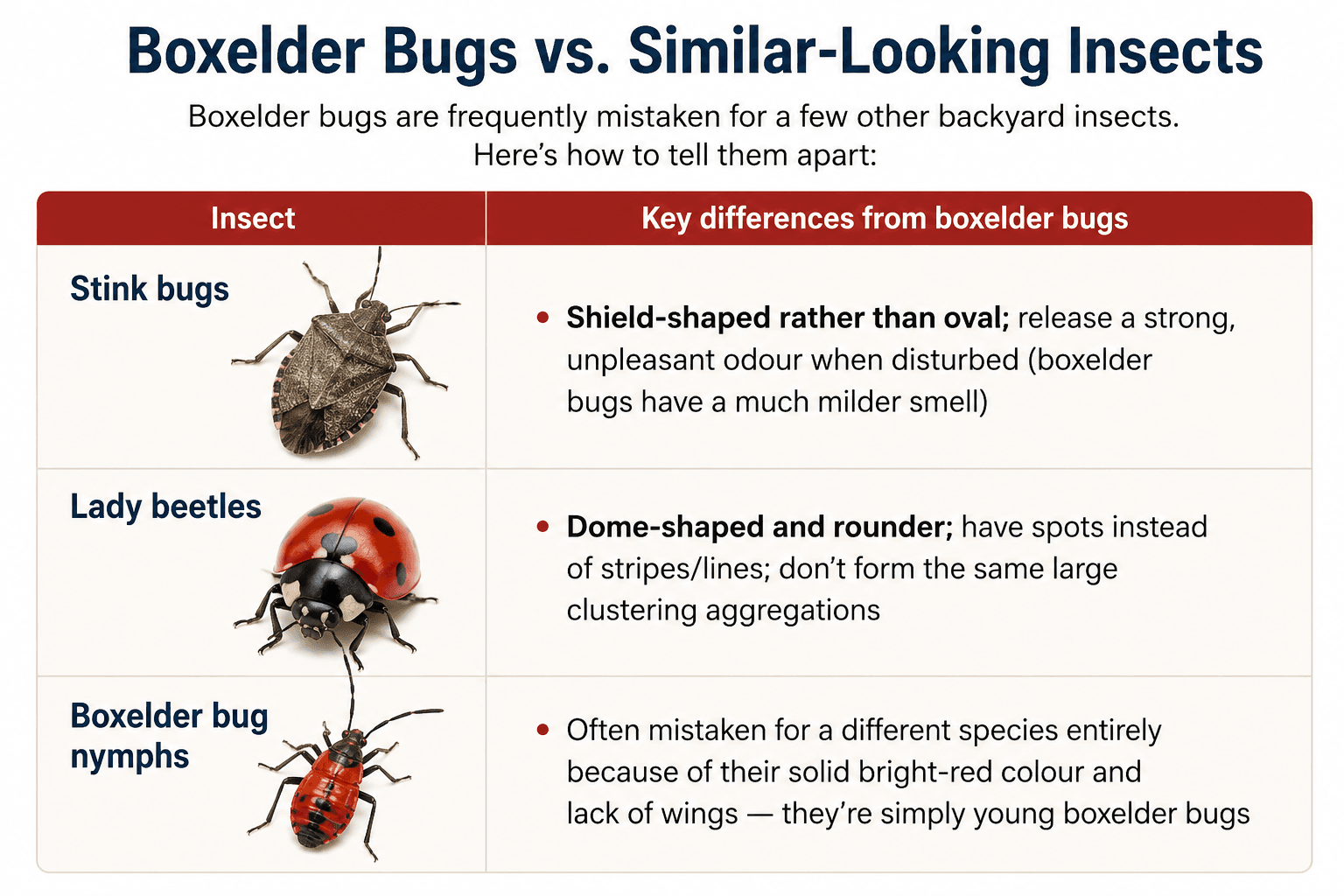
Boxelder Bugs vs. Similar-Looking Insects
Why Do You Keep Seeing Them? Life Cycle and Seasonal Behaviour
Boxelder bug numbers follow a predictable seasonal pattern, which is why they seem to appear "out of nowhere" at certain times of year.
In spring, adults that overwintered indoors or in sheltered spots become active again. Females lay clusters of eggs — typically in the range of 200 to 300 per female — in cracks in tree bark or nearby structures. Eggs hatch within roughly 10 to 19 days, and the nymphs feed on fallen seeds beneath host trees. Over the following weeks, nymphs pass through five stages (instars) before becoming winged adults.
During summer, boxelder bugs stay mostly outdoors, feeding and reproducing on their host trees, and rarely cause any nuisance to homeowners.
As temperatures cool in fall, adults begin gathering in large groups on warm, sun-exposed surfaces — south- and west-facing walls are their favourite — before migrating toward shelter for winter. This is the point at which most homeowners notice them: hundreds of bugs basking on siding, gathering around window frames, or working their way toward any gap that leads indoors.
Why they're drawn to your house specifically
Two things pull boxelder bugs toward a home: nearby Manitoba maple, maple, or ash trees, and warmth. These are cold-blooded insects, so as outdoor temperatures drop, the heat radiating from a sun-warmed wall — or leaking out through gaps around windows, vents, and poorly sealed siding — becomes irresistible. If your home has these kinds of small entry points, you're offering boxelder bugs exactly what they're looking for.
Once they're inside, boxelder bugs don't head for your kitchen or living space right away. They look for quiet, undisturbed voids close to the exterior — behind siding, inside wall cavities, in attics, or in sheds and outbuildings — where they can settle in for winter without being disturbed. This is also why an infestation can seem to "reappear" partway through winter: a stretch of unusually warm days is often enough to wake bugs from these hiding spots and send a few wandering into living areas looking for the sun again, even in the middle of January.
Do boxelder bug problems come back every year?
Often, yes — and the reason isn't bad luck. If the host trees, sun exposure, and entry points that attracted bugs last fall are all still in place, the same conditions will draw in a new generation the following year. This is why sealing entry points is worth treating as routine home maintenance rather than a one-time fix, especially on properties close to mature Manitoba maples, which are common throughout many established GTA neighbourhoods.
Are Boxelder Bugs Dangerous?
The good news: boxelder bugs are a nuisance, not a threat.
Health concerns
Boxelder bugs have piercing-sucking mouthparts built for feeding on plant seeds, not for biting. Bites are rare and only happen defensively if a bug is handled roughly, and any reaction is typically mild — comparable to a mosquito bite. They don't transmit diseases or carry pathogens. Some sensitive individuals may experience minor skin or eye irritation from repeated contact, but serious reactions are uncommon. They're also generally safe around pets, since their unpleasant taste tends to discourage animals from eating them.
Property impact
Boxelder bugs don't chew through wood, insulation, or building materials, and they won't damage fabrics or stored items. Their real property impact is cosmetic: in large numbers, their droppings can leave noticeable stains on siding, window sills, and curtains, and crushing them can release an unpleasant odour and leave marks that are genuinely difficult to clean off fabric and painted surfaces. This staining, more than anything else, is what makes an infestation worth addressing rather than ignoring.
How to Prevent and Control Boxelder Bugs
Prevention is far more effective — and far less work — than dealing with an established indoor infestation.
Seal entry points
This is the single most effective step you can take. Before boxelder bugs begin their fall migration indoors (ideally by late summer):
- Inspect window and door frames, inside and out, for gaps
- Apply quality caulk to seal any cracks or openings
- Replace worn weather stripping around doors
- Check garage doors closely — they often have the largest gaps
- Inspect siding for gaps and repair or reseal as needed
If you're already seeing large clusters on your home's exterior, some have likely found their way inside through existing gaps—a sign it's time to move quickly to seal the rest.
Manage your landscape
Since boxelder bugs shelter outdoors before attempting entry, landscape maintenance directly reduces how many end up at your door:
- Prune tree branches back so they don't touch or overhang the house
- Clear woodpiles, lumber stacks, and unused equipment near the foundation — all common outdoor hiding spots
- Rake up fallen leaves regularly in fall to reduce nearby shelter
Dealing with an existing aggregation
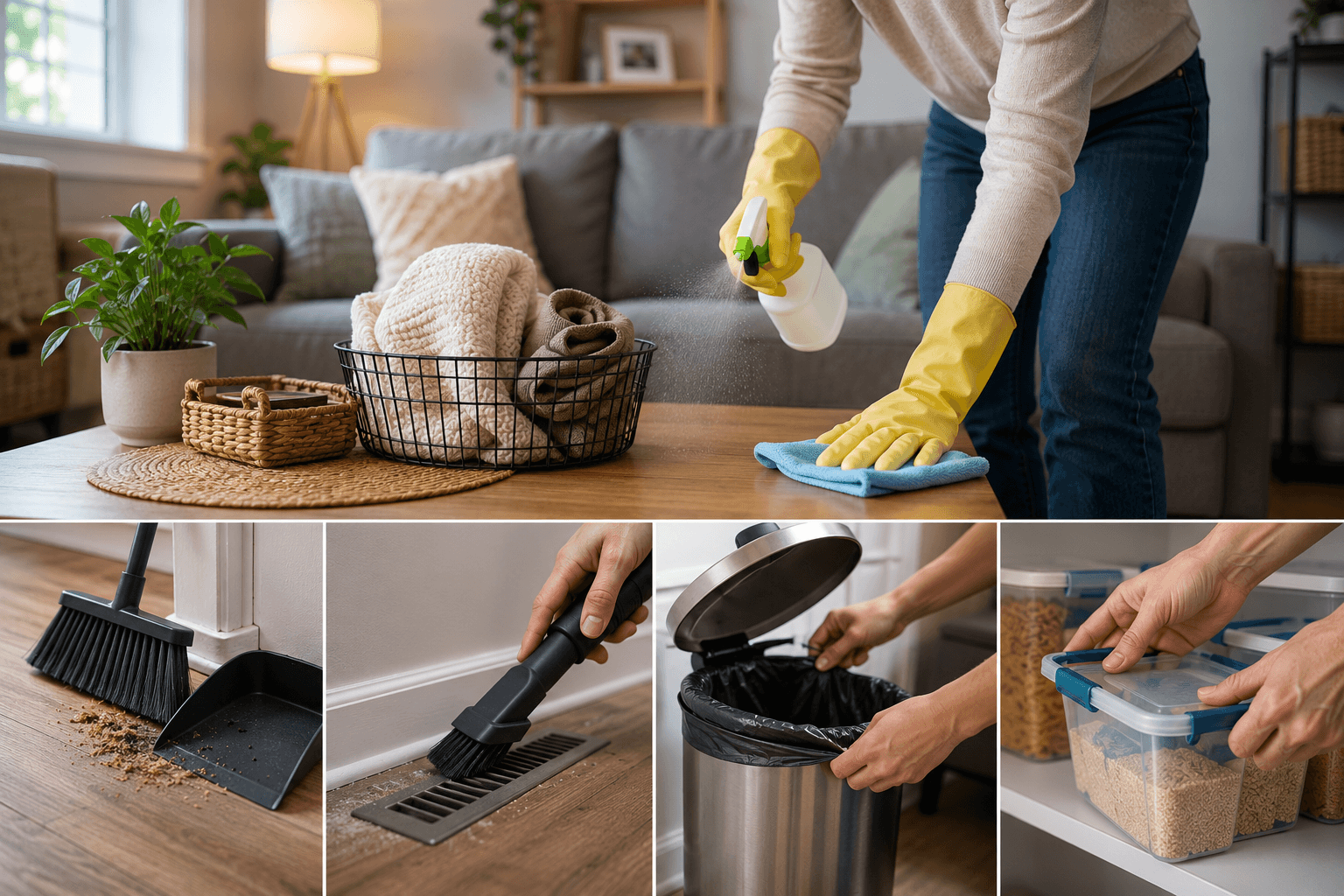
If bugs are already clustered on an exterior wall, a simple mix of dish soap and water in a spray bottle is often enough to knock down and kill an aggregation without resorting to pesticides — useful as a short-term measure while you finish sealing entry points. Bugs that have already made it indoors are best removed with a vacuum rather than crushed, both to avoid staining and the odour that comes with crushing them.
A few practical notes for the indoor cleanup:
- Empty the vacuum bag or canister outside right after use — bugs can survive the trip through a vacuum and crawl back out
- Avoid crushing bugs directly on fabric, curtains, or carpet, since this is exactly what causes the staining and odour homeowners want to avoid
- If you're finding a handful of bugs indoors every few days rather than a one-time cluster, that's usually a sign there's still an open entry point worth tracking down rather than a new infestation each time.
Do boxelder bugs need pesticide treatment?
For most homes, no. Because boxelder bugs don't damage structures or pose a health risk, exclusion (sealing entry points) and simple mechanical removal (vacuuming, soap-water spray) handle the vast majority of cases without needing chemical treatment. Pesticide application is generally reserved for severe, recurring aggregations where exclusion alone hasn't resolved the problem — and even then, targeted exterior treatment timed to early fall, before bugs move indoors, is far more effective than treating an aggregation after the fact.
When to call a professional
For persistent infestations, or if you'd like someone who does this daily to assess entry points and vulnerable areas, professional pest control services can provide targeted exclusion work and seasonal monitoring so the problem doesn't repeat every fall. This applies whether you're dealing with boxelder bugs in Toronto, Vaughan, or elsewhere across the GTA and South Simcoe region.
Frequently Asked Questions
Are boxelder bugs the same as ladybugs?
No. Boxelder bugs are oval and flattened with red or orange stripes, while lady beetles are dome-shaped with spots. They're often confused because both can appear in large numbers in fall, but they're unrelated insects.
Do boxelder bugs bite?
Rarely, and only defensively if handled. Their mouthparts are designed for feeding on plant seeds, not biting, so any bite is uncommon and causes at most mild, mosquito-bite-like irritation.
Are boxelder bugs harmful to pets?
No. They don't carry diseases, and their unpleasant taste generally keeps pets from wanting to eat them.
Will boxelder bugs damage my house?
No. They don't chew through wood, insulation, or building materials. Their main impact is cosmetic staining from droppings when they gather in large numbers.
What attracts boxelder bugs to my home?
Nearby Manitoba maple, maple, or ash trees, combined with warmth. As a cold-blooded insect, a boxelder bug is drawn to sun-warmed walls and any heat escaping through gaps around windows, vents, or siding.
How long do boxelder bugs live?
Adults typically live through a single season outdoors, with some surviving through winter in sheltered or indoor spots before dying off in spring after laying eggs for the next generation.
Are boxelder bugs found across all of Canada?
The Eastern boxelder bug is common across Ontario and eastern Canada. A closely related species, the Western boxelder bug, occupies British Columbia and points east from there — the two rarely overlap.
When do boxelder bugs go away?
Outdoor activity dies down once winter sets in, as bugs either move indoors to overwinter or die off. They reappear again in spring when temperatures warm, and the cycle repeats.
Key Takeaways
- Red bugs with black markings on your home's exterior are almost always boxelder bugs — a nuisance pest, not a dangerous one
- They're drawn to Manitoba maple, maple, and ash trees, plus warmth from sun-exposed walls and small gaps in your home's exterior
- They don't bite readily, don't spread disease, and don't damage your home's structure — their main downside is staining from droppings in large numbers
- Sealing entry points before late summer, combined with basic landscape maintenance, prevents most infestations before they start
- Persistent or large-scale problems are worth handing to a professional for targeted exclusion work
If you're dealing with a boxelder bug infestation or want preventive treatment before fall arrives, contact Pest Troopers for a targeted plan — or check our FAQ page for more common pest questions.